The AFID Conference aims to create a platform for South Asian countries to share and learn from each other and create a network of mutual support. Commonalities of culture, tradition and religious beliefs among these countries have made for better interaction and understanding of each other's experiences and difficulties. At the last conference on Jeju Island, Korea in August 2010, the Delhi-based organization, Samadhan, was selected as the host organization for AFID 2013.
The 21st AFID Conference will be held at the India Habitat Centre in New Delhi, India from 7-11 October, 2013. The theme of this conference will be "Towards Dignity & Quality of Life - Evolving Individual Capacity with Family & Community Participation”
To register please log onto http://www.afid2013.in/
Showing posts with label Intellectual Disability. Show all posts
Showing posts with label Intellectual Disability. Show all posts
Wednesday, April 24, 2013

Monday, April 1, 2013
Red Flags for Autism Spectrum Disorder
Autism
Spectrum Disorder (ASD) is a complex neurological and developmental disorder
that affects how a person acts and interacts with others, communicates, and
learns. ASD affects the structure and function of the brain and nervous system.
Because it affects development, ASD is called a developmental disorder. ASD can last throughout a person's life. People with this
disorder have problems with:
- Communication
- Interactions with other people
(social skills)
- Restricted interests and
repetitive behaviors
The
symptoms of one person with autism can be very different from the symptoms of
another person with autism. Health care providers think of autism as a spectrum disorder - a group of disorders with a range of similar
features.
The United Nations General
Assembly unanimously declared 2 April
as World Autism Awareness Day. On the eve we present before you certain valuable information for mass awareness.

ASD includes:
·
- Autistic disorder ("classic" autism). Autistic disorder is often what people think of when they think of autism.
- Asperger syndrome. This ASD usually involves milder symptoms, mostly
related to social behaviors.
- Pervasive developmental
disorder not otherwise specified (PDD-NOS,
or "atypical" autism). PDD-NOS includes some, but not all, of
the features of classic autism and/or Asperger syndrome.
One
person with autism may have mild symptoms, while another may have more serious
symptoms, but they both have ASD.
Despite
the range of possible symptoms, there are certain actions and behaviors that
are common in ASD and could signal that a child is on the autism spectrum.
Parents and caregivers who notice these "red flags" should
speak to their child's health care provider about autism and screening the
child for ASD.
In
general, the main signs and symptoms of ASD relate to:
- Communication
- Social behaviors
- Routines or repetitive
behaviors, sometimes called stereotyped behaviors
Red Flags for ASD
Communication
|
Note about these red flags:
Some of these red flags apply only at certain ages, so consider what's typical for other children your child's age. Some red flags are more strongly associated with autism than others. If your child shows any red flags for autism, talk to his or her health care provider right away. |
- Does
not respond to his/her name by 12 months of age
- Cannot
explain what he/she wants
- Language
skills are slow to develop or speech is delayed
- Doesn't
follow directions
- Seems
to hear sometimes, but not other times
- Doesn't
point or wave "bye-bye"
- Used
to say a few words or babble, but now does not
Social Behavior
- Doesn't
smile when smiled at
- Has
poor eye contact
- Seems
to prefer to play alone
- Gets
things for him/herself only
- Is
very independent for his/her age
- Seems
to be in his/her "own world"
- Seems
to tune people out
- Is
not interested in other children
- Doesn't
point out interesting objects by 14 months of age
- Doesn't
like to play "peek-a-boo"
- Doesn't
try to attract his/her parent's attention
Stereotyped Behavior
- Gets
"stuck" doing the same things over and over and can't move on to
other things
- Shows
unusual attachments to toys, objects, or routines (for example, always
holding a string or having to put on socks before pants)
- Spends
a lot of time lining things up or putting things in a certain order
- Repeats
words or phrases (sometimes called echolalia [pronounced ek-oh-LEY-lee-uh])
Other Behavior
- Doesn't
play "make believe" or pretend by 18 months of age
- Has
odd movement patterns
- Doesn't
know how to play with toys
- Does
things "early" compared to other children
- Walks
on his/her toes
- Doesn't
like to climb on things such as stairs
- Doesn't
imitate silly faces
- Seems
to stare at nothing or wander around with no purpose
- Throws
intense or violent tantrums
- Is
overly active, uncooperative, or resistant
- Seems
overly sensitive to noise
- Doesn't
like to be swung or bounced on his/her parent's knee, etc
Thursday, March 21, 2013
2013 WDSD awards declared
On Friday 15 March 2013, ahead of World Down Syndrome Day on Thursday 21 March, Down Syndrome International (DSi) announced the recipients of the 2013 World Down Syndrome Day Awards.
2013 is the fourth year of the World Down Syndrome Day Awards, presented to individuals or organisations whose voluntary, professional or scientific activities have strengthened and enriched the lives of people with Down syndrome, or contributed to scientific advancement related to Down syndrome.
This year’s recipients are as follows:
Voluntary and Professional Awards
1 individual with Down syndrome receives an award for outstanding self-advocacy:
Karen Gaffney (USA) – Long distance swimmer, motivational speaker and President of the Karen Gaffney Foundation. Karen advocates for the inclusion of people with disabilities in all walks of life, offering motivational workshops and inclusive programmes.
1 individual receives an award for outstanding voluntary activities:
Mr Ratnasabapathy Sivanandam (Singapore) – Co-Founder of Down Syndrome Association (Singapore), who has led the organisation of many important initiatives and events in Singapore and Asia including Asia Pacific Down Syndrome Conference, World Down Syndrome Congress and World Down Syndrome Day.
Scientific Awards
3 individuals receive awards for outstanding contribution towards scientific advancement related to Down syndrome:
Professor Tony Holland (UK) – Chair of the Intellectual and Developmental Disabilities Research Group, University of Cambridge, whose pioneering work includes extensive research on the relationship between Down syndrome and Alzheimer’s disease.
Dr Zan Mustacchi (Brazil) – Medical and Paediatric Geneticist, Genetics Department at Darcy Vargas Children’s Public Hospital in Sao Paulo, and Founder Member of Brazilian Federation of Associations of Down Syndrome who he represents on the National Health Council.
Professor Marie-Odile Réthoré (France) – Medical Director of Institut Jérôme Lejeune who collaborated with Professor Lejeune and who has dedicated a lifetime to the medical care of people with Down syndrome and scientific research.
All recipients are invited to a formal presentation of World Down Syndrome Day Awards for the years 2013-2015 taking place at the 12th World Down Syndrome Congress (WDSC) in Chennai, India in August 2015.
World Down Syndrome Day 2013
World Down Syndrome Day (WDSD) is a global awareness day observed on 21 March each year. This date (21/3) represents the 3 copies of chromosome 21, which is unique to people with Down syndrome (DS), and people and organisations worldwide observe this day in a variety of different ways.

DS is a life-long genetic condition from conception caused by the presence of an extra chromosome in a baby's cells affecting approximately 1 in 800 live births, although there is considerable variation worldwide. DS usually causes varying degrees of intellectual and physical disability and associated medical issues. With around 7 million people with Down syndrome living worldwide, it is the most common and recognised form of learning disability. But most people with DS face a harsh reality of low life expectancy, physical and psychological abuse, stigma and segregation, and limited life opportunities as children and adults. People with DS living in poverty face these challenges but it is also true across the spectrum of wealth due to educational, political, medical and social barriers.
On 19 December 2011, the United Nations General Assembly declared 21 March as World Down Syndrome Day. The General Assembly decided, with effect from 2012, to observe WDSD on 21 March each year, and invites all Member States, relevant organizations of the United Nations system and other international organizations, as well as civil society, including non-governmental organizations and the private sector, to observe WDSD in an appropriate manner, in order to raise public awareness of DS.

Down Syndrome International (DSi) is a UK based international charity, comprising a membership of individuals and organisations from all over the world, committed to ensuring quality of life and human rights for all people with DS. DSi invites everyone across the world to wear LOTS OF SOCKS on 21 March 2013 to raise awareness on WDSD. Their website says, “We want to get people talking about WDSD on 21 March, and we can do this if we all wear socks…But not just any socks...brightly coloured socks, mismatched socks, long socks, printed socks, 1 sock…maybe even 3 socks (or EXTRA socks) for 3 chromosomes. Or if you don’t normally wear socks then wear them. Just so long as they are socks which are on display and people will ask you about.”

DSi will also organise World Down Syndrome Day Conference on 21 March 2013 at the United Nations Headquarters, New York, USA. This year's World Down Syndrome Day Conference is entitled: "Right To Work". Article 27 of the UN CRPD recognises the right of persons with disabilities to work, on an equal basis with others; this includes the right to the opportunity to gain a living by work freely chosen or accepted in a labour market and work environment that is open, inclusive and accessible to persons with disabilities.
There will be presentations from people with Down syndrome, disability organisations, employers, service providers and others from around the world including North America, South America, Europe, Asia, Africa and Australia. One can watch the live UN webcast at http://webtv.un.org/
What to say, what not to say?
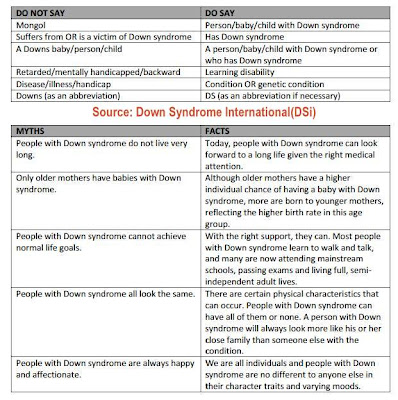
Useful resources:
WDSD official site
Down Syndrome International (DSi)
Indelible :A feature length documentary telling the inspiring stories of 7 people with Down syndrome in India, which is the official film of Down Syndrome Federation of India. This short version of the film was created specifically for the closing ceremony of WDSC 2012 in Cape Town, South Africa. Youtube link of the video is available at http://youtu.be/MMVfy6_nxp8
WDSD Events in India on 21 March 2013
Down Syndrome Federation ofIndia

DS is a life-long genetic condition from conception caused by the presence of an extra chromosome in a baby's cells affecting approximately 1 in 800 live births, although there is considerable variation worldwide. DS usually causes varying degrees of intellectual and physical disability and associated medical issues. With around 7 million people with Down syndrome living worldwide, it is the most common and recognised form of learning disability. But most people with DS face a harsh reality of low life expectancy, physical and psychological abuse, stigma and segregation, and limited life opportunities as children and adults. People with DS living in poverty face these challenges but it is also true across the spectrum of wealth due to educational, political, medical and social barriers.
On 19 December 2011, the United Nations General Assembly declared 21 March as World Down Syndrome Day. The General Assembly decided, with effect from 2012, to observe WDSD on 21 March each year, and invites all Member States, relevant organizations of the United Nations system and other international organizations, as well as civil society, including non-governmental organizations and the private sector, to observe WDSD in an appropriate manner, in order to raise public awareness of DS.

Down Syndrome International (DSi) is a UK based international charity, comprising a membership of individuals and organisations from all over the world, committed to ensuring quality of life and human rights for all people with DS. DSi invites everyone across the world to wear LOTS OF SOCKS on 21 March 2013 to raise awareness on WDSD. Their website says, “We want to get people talking about WDSD on 21 March, and we can do this if we all wear socks…But not just any socks...brightly coloured socks, mismatched socks, long socks, printed socks, 1 sock…maybe even 3 socks (or EXTRA socks) for 3 chromosomes. Or if you don’t normally wear socks then wear them. Just so long as they are socks which are on display and people will ask you about.”

DSi will also organise World Down Syndrome Day Conference on 21 March 2013 at the United Nations Headquarters, New York, USA. This year's World Down Syndrome Day Conference is entitled: "Right To Work". Article 27 of the UN CRPD recognises the right of persons with disabilities to work, on an equal basis with others; this includes the right to the opportunity to gain a living by work freely chosen or accepted in a labour market and work environment that is open, inclusive and accessible to persons with disabilities.
There will be presentations from people with Down syndrome, disability organisations, employers, service providers and others from around the world including North America, South America, Europe, Asia, Africa and Australia. One can watch the live UN webcast at http://webtv.un.org/
What to say, what not to say?

Useful resources:
WDSD official site
Down Syndrome International (DSi)
Indelible :A feature length documentary telling the inspiring stories of 7 people with Down syndrome in India, which is the official film of Down Syndrome Federation of India. This short version of the film was created specifically for the closing ceremony of WDSC 2012 in Cape Town, South Africa. Youtube link of the video is available at http://youtu.be/MMVfy6_nxp8
WDSD Events in India on 21 March 2013
Down Syndrome Federation ofIndia
Sunday, December 9, 2012
Declaration on the Rights of Persons with Intellectual Disability

The article has used the word 'mentally retarded' which I don't find appropriate and accordingly replaced with 'Intellectual Disability' in the title. However I shall use the original source below.
Declaration on the Rights of Mentally Retarded Persons
Proclaimed by General Assembly resolution 2856 (XXVI) of 20 December 1971
The General Assembly ,
Mindful of the pledge of the States Members of the United Nations under the Charter to take joint and separate action in co-operation with the Organization to promote higher standards of living, full employment and conditions of economic and social progress and development,
Reaffirming faith in human rights and fundamental freedoms and in the principles of peace, of the dignity and worth of the human person and of social justice proclaimed in the Charter,
Recalling the principles of the Universal Declaration of Human Rights, the International Covenants on Human Rights, the Declaration of the Rights of the Child and the standards already set for social progress in the constitutions, conventions, recommendations and resolutions of the International Labour Organisation, the United Nations Educational, Scientific and Cultural Organization, the World Health Organization, the United Nations Children's Fund and other organizations concerned,
Emphasizing that the Declaration on Social Progress and Development has proclaimed the necessity of protecting the rights and assuring the welfare and rehabilitation of the physically and mentally disadvantaged,
Bearing in mind the necessity of assisting mentally retarded persons to develop their abilities in various fields of activities and of promoting their integration as far as possible in normal life,
Aware that certain countries, at their present stage of development, can devote only limited efforts to this end,
Proclaims this Declaration on the Rights of Mentally Retarded Persons and calls for national and international action to en sure that it will be used as a common basis and frame of reference for the protection of these rights:
1. The mentally retarded person has, to the maximum degree of feasibility, the same rights as other human beings.
2. The mentally retarded person has a right to proper medical care and physical therapy and to such education, training, rehabilitation and guidance as will enable him to develop his ability and maximum potential.
3. The mentally retarded person has a right to economic security and to a decent standard of living. He has a right to perform productive work or to engage in any other meaningful occupation to the fullest possible extent of his capabilities.
4. Whenever possible, the mentally retarded person should live with his own family or with foster parents and participate in different forms of community life. The family with which he lives should receive assistance. If care in an institution becomes necessary, it should be provided in surroundings and other circumstances as close as possible to those of normal life.
5. The mentally retarded person has a right to a qualified guardian when this is required to protect his personal well-being and interests.
6. The mentally retarded person has a right to protection from exploitation, abuse and degrading treatment. If prosecuted for any offence, he shall have a right to due process of law with full recognition being given to his degree of mental responsibility.
7. Whenever mentally retarded persons are unable, because of the severity of their handicap, to exercise all their rights in a meaningful way or it should become necessary to restrict or deny some or all of these rights, the procedure used for that restriction or denial of rights must contain proper legal safeguards against every form of abuse. This procedure must be based on an evaluation of the social capability of the mentally retarded person by qualified experts and must be subject to periodic review and to the right of appeal to higher authorities.

Friday, October 5, 2012
Phobias in Poetry
A poem, a work of art, a photograph, a film clip, or a brief passage
from a literary work often can expose important aspects of how a person
experiences an illness in ways that science cannot. This ability to
transcend the limits of current scientific knowledge, to illuminate
important aspects of suffering and sickness, and to enrich understanding
of healing makes art and the humanities essential parts of medicine and
medical education.
Taking this into consideration, we (Enabling Unit members) worked on the the classic 'The Rime of the Ancient Mariner' by Coleridge and analysed it from a Doctor's specs as well as a reader's lens. The outcome 'Phobias in Poetry' is published under 'New Horizon' category of PubMed indexed IJPM. You can read the full article here.


Taking this into consideration, we (Enabling Unit members) worked on the the classic 'The Rime of the Ancient Mariner' by Coleridge and analysed it from a Doctor's specs as well as a reader's lens. The outcome 'Phobias in Poetry' is published under 'New Horizon' category of PubMed indexed IJPM. You can read the full article here.
Tuesday, September 18, 2012
Apple iOS 6 offers more access for PwD's
Apple announced at press event yesterday that the newest version of the
company’s mobile operating system, iOS 6, will be available for users to
download on September 19.
 The new iOS 6 looks to have gotten tons of new integrated features. One
new feature that might be overlooked, but certainly deserves some
attention, is the new Guided Access mode for iOS devices.
The new iOS 6 looks to have gotten tons of new integrated features. One
new feature that might be overlooked, but certainly deserves some
attention, is the new Guided Access mode for iOS devices.
Guided Access is a form of accessibility software for operating system and its make it easier for people with vision, hearing, learning and mobility disabilities to get the most from their iOS devices. Guided Access helps students with disabilities such as autism remain on task and focused on content. It allows a parent or teacher the ability to have full control of how an iOS device can be used. For example, the home button and all other hardware buttons can be locked, motion sensitivity can be disabled, or a certain portion of the screen can be made inactive toward touch.
VoiceOver, the screen reader for users who are blind and low-vision, is now integrated with Maps, AssistiveTouch, and Zoom.

Guided Access is a form of accessibility software for operating system and its make it easier for people with vision, hearing, learning and mobility disabilities to get the most from their iOS devices. Guided Access helps students with disabilities such as autism remain on task and focused on content. It allows a parent or teacher the ability to have full control of how an iOS device can be used. For example, the home button and all other hardware buttons can be locked, motion sensitivity can be disabled, or a certain portion of the screen can be made inactive toward touch.
VoiceOver, the screen reader for users who are blind and low-vision, is now integrated with Maps, AssistiveTouch, and Zoom.
“And we have some great enhancements
for accessibility” said Scott Forstall at Apple press event. The update
will be free and available for iOS devices 3GS, iPhone 4, and iPhone 4S;
the 4th generation iPod touch; and the 2nd and 3rd generation iPads.
By Aqeel Qureshi GAATES news
Subscribe to:
Posts (Atom)